
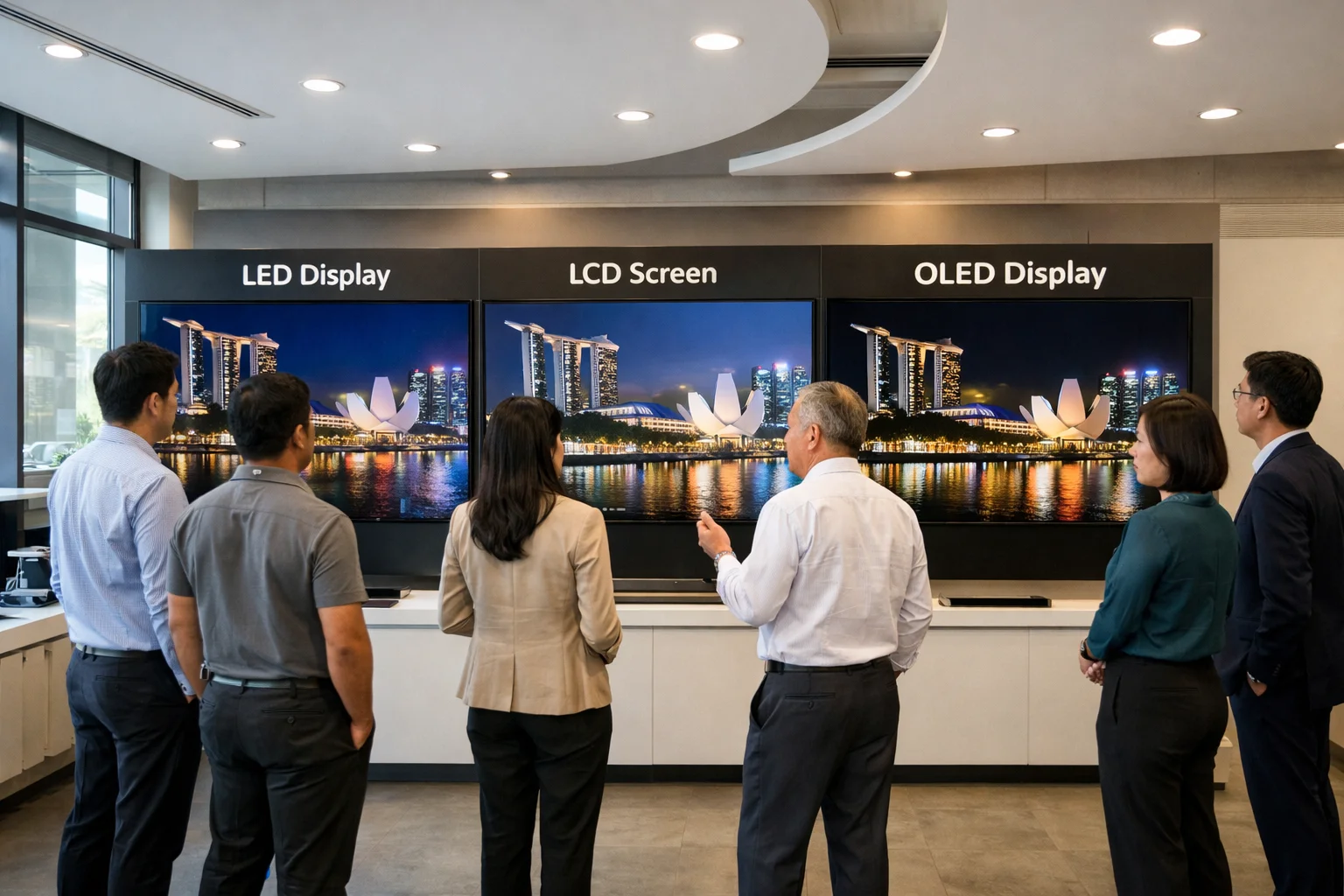
Intro: LED Display vs LCD vs OLED
Comparing led display vs lcd vs oled becomes confusing when teams evaluate only showroom visuals. Business environments have different needs: some prioritize scale and durability, some prioritize fine detail, and others prioritize premium aesthetics.
This guide compares the technologies through operational fit rather than marketing claims.
Quick Answer: LED Display vs LCD vs OLED
LED is usually strongest for large-format scalability and demanding visibility environments. LCD is practical for standardized indoor use with predictable cost. OLED excels in premium close-view experience where contrast and design aesthetics matter.
The best choice depends on where the screen is installed, how long it runs, and what type of content users must read.
Why LED Display vs LCD vs OLED Matters in Cambodia
Cambodia projects often combine indoor corporate usage and high-ambient commercial zones. A single technology strategy may not fit all zones in one organization.
Climate and operating behavior also influence choice. Long-hour usage, dust exposure, and maintenance resource availability should be considered alongside visual preference.
LED Display vs LCD vs OLED Core Explanation
Technology selection should begin with business objective and user behavior, then move into technical and financial trade-offs. Decision documents should include expected lifespan, maintenance effort, and upgrade path.
When teams skip this process, procurement may optimize short-term cost while operations absorb long-term inefficiency.
LED Display vs LCD vs OLED Technical Decision Logic
Technical comparison should include brightness headroom, modularity, panel replacement complexity, viewing-angle behavior, and content type compatibility.
For large communication walls, evaluate LED Display in Cambodia options first. For specialized environments, map requirements against indoor LED display solutions and conventional alternatives with transparent trade-off notes.
LED Display vs LCD vs OLED Execution and Operational Control
Execution planning differs by technology. LED projects often need structural planning and calibration workflows. LCD arrays require bezel and panel-uniformity management. OLED deployments need careful environment control and usage policy.
Operational reliability should be paired with service and support in Cambodia planning so each technology’s support model is clear before approval.
LED Display vs LCD vs OLED Buying, Planning, and Cost Factors
Total cost of ownership should include replacement policy, downtime risk, maintenance skill requirements, and energy profile. Low initial cost does not always mean lower five-year cost.
Comparison checklist:
- Define required screen size and future expansion probability
- Classify ambient light and viewing angle conditions
- Estimate maintenance complexity and spare availability
- Validate content detail and readability expectations
- Align technology with duty cycle and business criticality
Common LED Display vs LCD vs OLED Mistakes to Avoid
Common mistake: selecting technology by visual impression alone. Another mistake: forcing one technology for all business zones without use-case differentiation.
Other pitfalls include no lifecycle budget, no service response plan, and no clear ownership for calibration or panel replacement.
Recommended Use Cases for LED Display vs LCD vs OLED
Technology fit should reflect context.
Recommended patterns:
- LED for large dynamic communication walls
- LCD for structured indoor information networks
- OLED for premium, design-driven close-view zones
- Hybrid portfolio for organizations with mixed communication needs
LED Display vs LCD vs OLED Local Scenario Walkthrough
Cambodia projects often combine indoor corporate usage and high-ambient commercial zones. A single technology strategy may not fit all zones in one organization.
Climate and operating behavior also influence choice. Long-hour usage, dust exposure, and maintenance resource availability should be considered alongside visual preference.
Technology fit should reflect context.
Recommended patterns:
- LED for large dynamic communication walls
- LCD for structured indoor information networks
- OLED for premium, design-driven close-view zones
- Hybrid portfolio for organizations with mixed communication needs
For local validation, teams should run a short pilot test before full deployment. The pilot should confirm readability, operational behavior, response flow, and owner accountability under real daily usage. A controlled pilot usually reveals risk earlier than full rollout and helps stakeholders approve expansion with evidence rather than assumptions.
LED Display vs LCD vs OLED Implementation Playbook
Execution planning differs by technology. LED projects often need structural planning and calibration workflows. LCD arrays require bezel and panel-uniformity management. OLED deployments need careful environment control and usage policy.
Operational reliability should be paired with service and support in Cambodia planning so each technology’s support model is clear before approval.
Total cost of ownership should include replacement policy, downtime risk, maintenance skill requirements, and energy profile. Low initial cost does not always mean lower five-year cost.
Comparison checklist:
- Define required screen size and future expansion probability
- Classify ambient light and viewing angle conditions
- Estimate maintenance complexity and spare availability
- Validate content detail and readability expectations
- Align technology with duty cycle and business criticality
Common mistake: selecting technology by visual impression alone. Another mistake: forcing one technology for all business zones without use-case differentiation.
Other pitfalls include no lifecycle budget, no service response plan, and no clear ownership for calibration or panel replacement.
Execution playbook discipline means each handover has sign-off criteria, each incident has escalation contact, and each optimization cycle has an owner. Teams that document this playbook once can reuse it across future projects and reduce implementation learning cost.
LED Display vs LCD vs OLED Performance Metrics and Review
LED is usually strongest for large-format scalability and demanding visibility environments. LCD is practical for standardized indoor use with predictable cost. OLED excels in premium close-view experience where contrast and design aesthetics matter.
The best choice depends on where the screen is installed, how long it runs, and what type of content users must read.
Mugnee helps teams translate business objectives into technology selection with practical implementation and support planning. This reduces decision risk and cross-team confusion.
For complex environments, Mugnee can build phased recommendation matrices that compare technologies by zone.
There is no universal winner between LED, LCD, and OLED. The best technology is the one that fits your environment, scale, and operational model.
Looking for LED Display solutions in Cambodia? Explore Mugnee's LED Display page: https://mugneekh.com/led-display/
Helpful links:
- LED Display in Cambodia
- indoor LED display solutions
- service and support in Cambodia
- request a quotation
- outdoor LED billboard solutions
A useful review framework should track at least five indicators: visual readability score, uptime percentage, response-time compliance, content refresh cadence, and business impact signal. Reviewing these metrics monthly helps leadership decide whether to optimize settings, adjust content strategy, or expand deployment scope.
LED Display vs LCD vs OLED Decision Matrix and Next 90 Days
Technical comparison should include brightness headroom, modularity, panel replacement complexity, viewing-angle behavior, and content type compatibility.
For large communication walls, evaluate LED Display in Cambodia options first. For specialized environments, map requirements against indoor LED display solutions and conventional alternatives with transparent trade-off notes.
Total cost of ownership should include replacement policy, downtime risk, maintenance skill requirements, and energy profile. Low initial cost does not always mean lower five-year cost.
Comparison checklist:
- Define required screen size and future expansion probability
- Classify ambient light and viewing angle conditions
- Estimate maintenance complexity and spare availability
- Validate content detail and readability expectations
- Align technology with duty cycle and business criticality
Technology fit should reflect context.
Recommended patterns:
- LED for large dynamic communication walls
- LCD for structured indoor information networks
- OLED for premium, design-driven close-view zones
- Hybrid portfolio for organizations with mixed communication needs
Mugnee helps teams translate business objectives into technology selection with practical implementation and support planning. This reduces decision risk and cross-team confusion.
For complex environments, Mugnee can build phased recommendation matrices that compare technologies by zone.
For the next ninety days, teams should run a decision matrix that scores technical suitability, financial predictability, execution readiness, and support reliability. A matrix-based review keeps decisions objective and helps avoid preference-driven approvals that can create future operational risk.
A practical matrix should also record owner name, review date, risk grade, and corrective action deadline for every open issue. This simple discipline improves accountability and helps leadership track whether implementation quality is improving month after month.
Why Businesses Choose Mugnee for LED Display vs LCD vs OLED
Mugnee helps teams translate business objectives into technology selection with practical implementation and support planning. This reduces decision risk and cross-team confusion.
For complex environments, Mugnee can build phased recommendation matrices that compare technologies by zone.
Conclusion: LED Display vs LCD vs OLED Decision Checklist
There is no universal winner between LED, LCD, and OLED. The best technology is the one that fits your environment, scale, and operational model.
Looking for LED Display solutions in Cambodia? Explore Mugnee's LED Display page: https://mugneekh.com/led-display/
Helpful links:
Recommended Internal Links
FAQ
Which technology is best for large commercial walls?v
LED is usually best for large modular walls that need scale and strong visibility.
When is LCD a better option?v
LCD works well for structured indoor deployments with standardized sizing needs.
Is OLED suitable for all business environments?v
No. OLED is strongest in premium indoor close-view contexts, not all operating environments.
Should one company use multiple technologies?v
Yes, hybrid strategy is often the most practical for mixed-zone business needs.
How should final decision be made?v
Use objective criteria: environment, scale, duty cycle, maintenance capacity, and lifecycle cost.
Need help choosing an LED display?
Share your use case and location. Mugnee Cambodia will help with scope, quotation planning, and installation support.
Related Articles
Continue with related buyer guides from the same topic cluster.

Digital Signage Solutions in Cambodia for Retail, Office, and Hospitality
Practical digital signage planning for Cambodia retail, office, and hotel environments.
Read More
LED Display in Cambodia: Complete Buyer's Guide
A complete Cambodia-focused planning guide for business LED display projects.
Read More
LED Display Price in Cambodia: What Affects the Cost in 2026
Understand what truly drives LED display price in Cambodia.
Read More