

Intro: Indoor vs Outdoor LED Display
The indoor vs outdoor led display decision is where many projects win or fail. Both look similar in marketing photos, but their operating assumptions are different. Indoor products prioritize close-view quality and controlled light response, while outdoor products are engineered for exposure, distance, and weather resilience.
This article helps buyers avoid category mistakes before procurement. If the environment is misclassified, long-term performance usually declines regardless of initial image quality.
Quick Answer: Indoor vs Outdoor LED Display
Choose indoor LED when audiences stand close, ambient light is controlled, and content needs fine detail. Choose outdoor LED when installation is exposed to sun, rain, dust, and long-distance visibility requirements.
In borderline environments such as semi-open façades, run a technical survey before selection. Assumptions based on “covered area” are often wrong in monsoon conditions.
Why Indoor vs Outdoor LED Display Matters in Cambodia
Cambodia climate amplifies this choice. Heat and humidity stress connectors and power units differently in exposed environments, while city dust and traffic pollution affect maintenance cycles.
Project location matters too. Downtown Phnom Penh storefronts may need high daytime readability but controlled night dimming. Coastal sites in Sihanoukville may need stronger sealing and corrosion-aware planning.
Indoor vs Outdoor LED Display Core Explanation
The correct framework is environment-first, then specification. Start with site classification, then evaluate distance, brightness target, and access for maintenance. Avoid the opposite sequence where teams pick hardware first and retrofit the environment later.
When classification is correct, every downstream decision becomes easier: budget, structure, safety planning, and service SLA.
Indoor vs Outdoor LED Display Technical Decision Logic
Technical comparison should include ingress protection, thermal behavior, brightness range, cabinet weight, and service access. For close-view corporate interiors, fine pitch and low-glare output often matter most.
Compare both indoor LED display solutions and outdoor LED billboard solutions using real site photos and measured distances, not generic showroom demos.
Indoor vs Outdoor LED Display Execution and Operational Control
Execution risks are different by class. Outdoor deployment adds structural and weatherproof checks. Indoor deployment often adds interior finish coordination and glare-control tuning.
Operationally, both need clear owner for content publishing, brightness scheduling, and fault escalation. Align this with service and support in Cambodia before handover.
Indoor vs Outdoor LED Display Buying, Planning, and Cost Factors
Cost differences are not only hardware-related. Outdoor projects typically include stronger structure and protection scope. Indoor projects may need cleaner cable integration and aesthetic finish constraints.
Decision checklist:
- Confirm true installation environment category
- Map nearest and farthest viewing distances
- Validate brightness policy for day/night operation
- Include preventive maintenance plan in budget
- Document commissioning acceptance criteria
Common Indoor vs Outdoor LED Display Mistakes to Avoid
Most common mistake: using indoor-grade hardware in semi-outdoor environments. Second common mistake: overpaying for fine pitch outdoors where distance does not justify it.
Other avoidable issues:
- No dimming policy for nighttime visibility
- No planned access path for maintenance
- No documented owner for post-launch operation
- Confusing “water-resistant” marketing wording with full project protection requirements
Recommended Use Cases for Indoor vs Outdoor LED Display
Use-case selection should follow audience behavior.
Recommended applications:
- Indoor: boardrooms, showrooms, reception walls, command rooms
- Outdoor: roadside campaigns, façade advertising, public information screens
- Hybrid projects: multi-zone campuses with both interior and exterior display logic
Each case should be designed with separate performance KPI rather than one generic success metric.
Indoor vs Outdoor LED Display Local Scenario Walkthrough
Cambodia climate amplifies this choice. Heat and humidity stress connectors and power units differently in exposed environments, while city dust and traffic pollution affect maintenance cycles.
Project location matters too. Downtown Phnom Penh storefronts may need high daytime readability but controlled night dimming. Coastal sites in Sihanoukville may need stronger sealing and corrosion-aware planning.
Use-case selection should follow audience behavior.
Recommended applications:
- Indoor: boardrooms, showrooms, reception walls, command rooms
- Outdoor: roadside campaigns, façade advertising, public information screens
- Hybrid projects: multi-zone campuses with both interior and exterior display logic
Each case should be designed with separate performance KPI rather than one generic success metric.
For local validation, teams should run a short pilot test before full deployment. The pilot should confirm readability, operational behavior, response flow, and owner accountability under real daily usage. A controlled pilot usually reveals risk earlier than full rollout and helps stakeholders approve expansion with evidence rather than assumptions.
Indoor vs Outdoor LED Display Implementation Playbook
Execution risks are different by class. Outdoor deployment adds structural and weatherproof checks. Indoor deployment often adds interior finish coordination and glare-control tuning.
Operationally, both need clear owner for content publishing, brightness scheduling, and fault escalation. Align this with service and support in Cambodia before handover.
Cost differences are not only hardware-related. Outdoor projects typically include stronger structure and protection scope. Indoor projects may need cleaner cable integration and aesthetic finish constraints.
Decision checklist:
- Confirm true installation environment category
- Map nearest and farthest viewing distances
- Validate brightness policy for day/night operation
- Include preventive maintenance plan in budget
- Document commissioning acceptance criteria
Most common mistake: using indoor-grade hardware in semi-outdoor environments. Second common mistake: overpaying for fine pitch outdoors where distance does not justify it.
Other avoidable issues:
- No dimming policy for nighttime visibility
- No planned access path for maintenance
- No documented owner for post-launch operation
- Confusing “water-resistant” marketing wording with full project protection requirements
Execution playbook discipline means each handover has sign-off criteria, each incident has escalation contact, and each optimization cycle has an owner. Teams that document this playbook once can reuse it across future projects and reduce implementation learning cost.
Indoor vs Outdoor LED Display Performance Metrics and Review
Choose indoor LED when audiences stand close, ambient light is controlled, and content needs fine detail. Choose outdoor LED when installation is exposed to sun, rain, dust, and long-distance visibility requirements.
In borderline environments such as semi-open façades, run a technical survey before selection. Assumptions based on “covered area” are often wrong in monsoon conditions.
Mugnee helps buyers classify environment correctly before specification is finalized. This prevents costly rework and improves technical confidence during procurement review.
Teams typically receive support across survey, technical recommendation, installation sequence, and post-launch tuning to keep visuals stable across seasons.
Indoor and outdoor LED are different operational systems. The best choice is the one aligned to environment, distance, and ownership model.
Looking for LED Display solutions in Cambodia? Explore Mugnee's LED Display page: https://mugneekh.com/led-display/
Useful links:
- indoor LED display solutions
- outdoor LED billboard solutions
- service and support in Cambodia
- request a quotation
- LED Display in Cambodia
A useful review framework should track at least five indicators: visual readability score, uptime percentage, response-time compliance, content refresh cadence, and business impact signal. Reviewing these metrics monthly helps leadership decide whether to optimize settings, adjust content strategy, or expand deployment scope.
Indoor vs Outdoor LED Display Decision Matrix and Next 90 Days
Technical comparison should include ingress protection, thermal behavior, brightness range, cabinet weight, and service access. For close-view corporate interiors, fine pitch and low-glare output often matter most.
Compare both indoor LED display solutions and outdoor LED billboard solutions using real site photos and measured distances, not generic showroom demos.
Cost differences are not only hardware-related. Outdoor projects typically include stronger structure and protection scope. Indoor projects may need cleaner cable integration and aesthetic finish constraints.
Decision checklist:
- Confirm true installation environment category
- Map nearest and farthest viewing distances
- Validate brightness policy for day/night operation
- Include preventive maintenance plan in budget
- Document commissioning acceptance criteria
Use-case selection should follow audience behavior.
Recommended applications:
- Indoor: boardrooms, showrooms, reception walls, command rooms
- Outdoor: roadside campaigns, façade advertising, public information screens
- Hybrid projects: multi-zone campuses with both interior and exterior display logic
Each case should be designed with separate performance KPI rather than one generic success metric.
Mugnee helps buyers classify environment correctly before specification is finalized. This prevents costly rework and improves technical confidence during procurement review.
Teams typically receive support across survey, technical recommendation, installation sequence, and post-launch tuning to keep visuals stable across seasons.
For the next ninety days, teams should run a decision matrix that scores technical suitability, financial predictability, execution readiness, and support reliability. A matrix-based review keeps decisions objective and helps avoid preference-driven approvals that can create future operational risk.
A practical matrix should also record owner name, review date, risk grade, and corrective action deadline for every open issue. This simple discipline improves accountability and helps leadership track whether implementation quality is improving month after month.
Why Businesses Choose Mugnee for Indoor vs Outdoor LED Display
Mugnee helps buyers classify environment correctly before specification is finalized. This prevents costly rework and improves technical confidence during procurement review.
Teams typically receive support across survey, technical recommendation, installation sequence, and post-launch tuning to keep visuals stable across seasons.
Conclusion: Indoor vs Outdoor LED Display Decision Checklist
Indoor and outdoor LED are different operational systems. The best choice is the one aligned to environment, distance, and ownership model.
Looking for LED Display solutions in Cambodia? Explore Mugnee's LED Display page: https://mugneekh.com/led-display/
Useful links:
Recommended Internal Links
FAQ
Can indoor LED be used in covered outdoor areas?v
Usually no, because moisture and airborne dust still create reliability risks in semi-open zones.
Why do outdoor systems cost more in many projects?v
They often require higher brightness, stronger protection, and additional structure planning.
What decides whether pitch should be fine or wide?v
Nearest viewing distance and content detail requirements are the main factors.
Is maintenance planning different for indoor and outdoor?v
Yes. Outdoor systems typically need stricter preventive schedules and access planning.
What is the first practical step in this comparison?v
Classify the exact environment and validate it with a site survey before procurement.
Need help choosing an LED display?
Share your use case and location. Mugnee Cambodia will help with scope, quotation planning, and installation support.
Related Articles
Continue with related buyer guides from the same topic cluster.
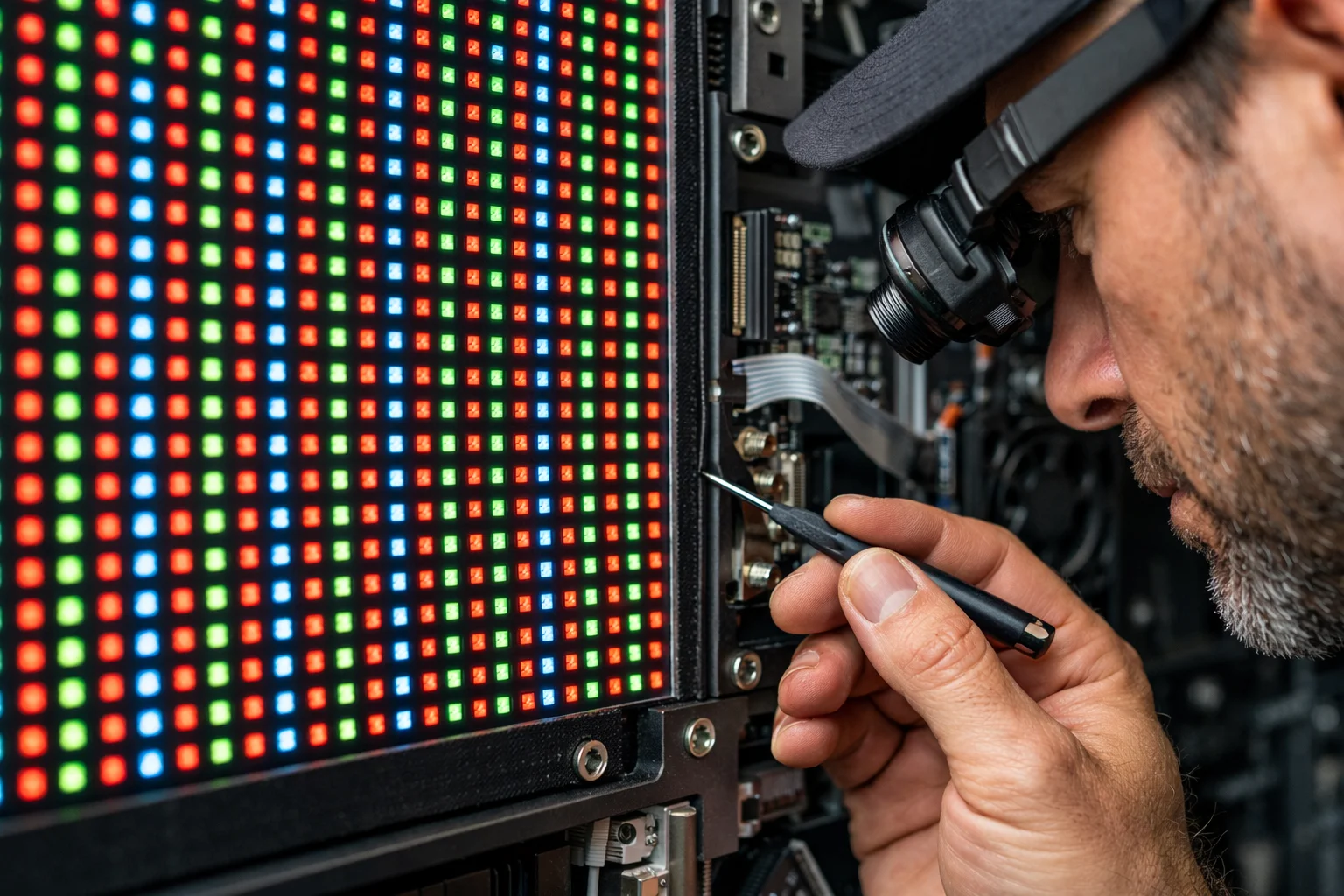
How to Choose the Right Pixel Pitch for LED Display
Select pixel pitch by viewing distance, content type, and budget.
Read More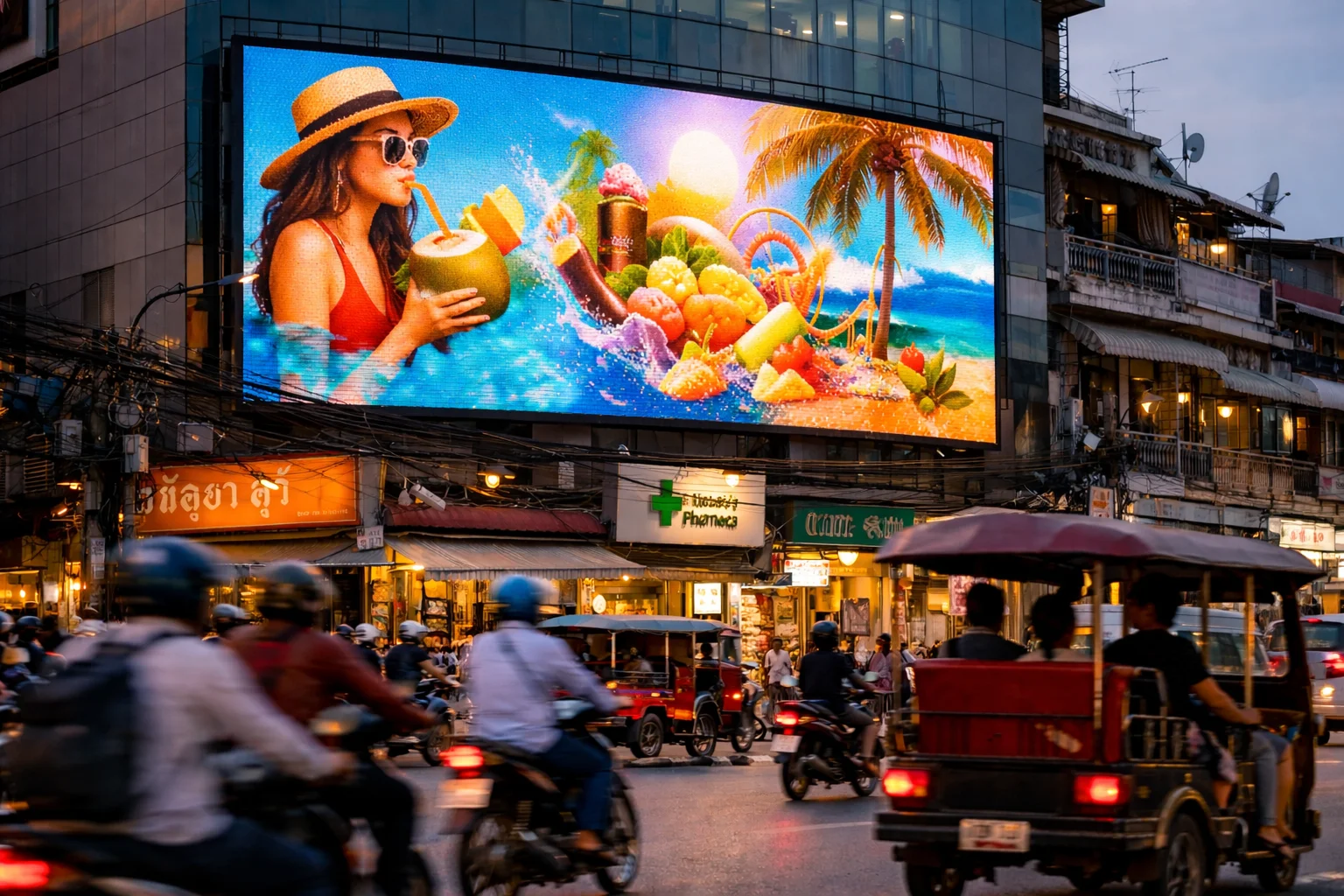
Outdoor LED Billboard in Cambodia: Best Uses for Advertising
A buyer guide for outdoor LED billboard strategy and execution in Cambodia.
Read More
LED Display in Cambodia: Complete Buyer's Guide
A complete Cambodia-focused planning guide for business LED display projects.
Read More